
How to Choose the Right Oil Mill Machine for Your Business | Zenith Power

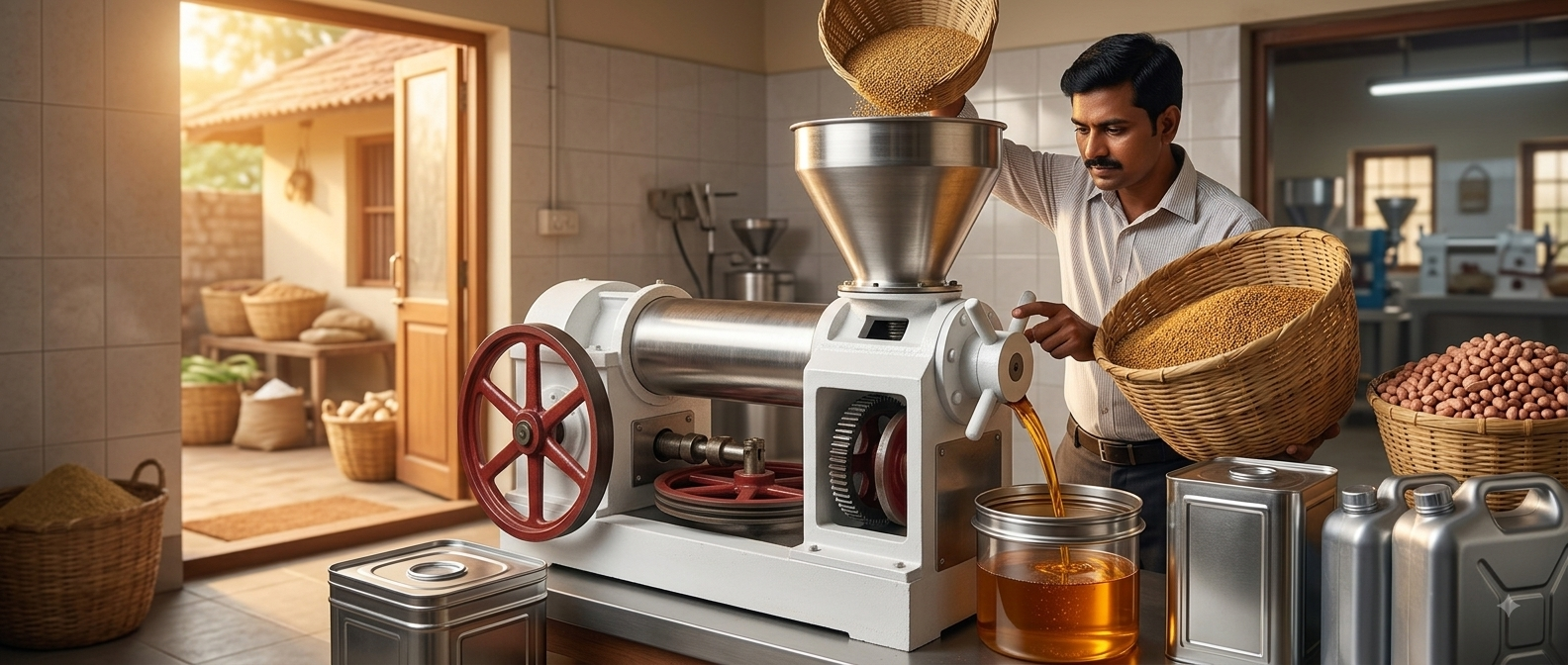
Choose the oil mill machine that matches your business — not simply the machine with the biggest capacity.
Starting an oil extraction business can be a promising opportunity for farmers, small entrepreneurs, food-processing businesses, and commercial operators. However, choosing the right oil mill machine is an important decision because the machine you select can affect your production capacity, power requirements, operating costs, workflow, and future business expansion.
Different businesses have different requirements. A small entrepreneur may not need the same machine as a commercial oil-processing unit. Zenith Power offers oil mill machines alongside agricultural equipment, generators, pumps, sprayers, dairy machines, and other farming-related products. Its current oil mill range includes the ZENITHPOWER 6YL-80 (5.5KW), 6YL-95A (7.5KW) Industrial Oil Mill, and 6YL-120A (11KW) Industrial Oil Mill, all listed without motors.
What Is an Oil Mill Machine — And Why Choosing the Right One Matters
An oil mill machine is equipment used to extract oil from oil-bearing seeds and other suitable raw materials. Depending on the raw material and machine configuration, oil extraction may involve several stages:
Oil mills can be used with suitable oilseeds such as groundnut, mustard, sesame, sunflower, soybean and other oil-bearing materials, depending on the machine's specifications. For a business owner, the objective is not simply to purchase the biggest machine available — the better approach is to choose equipment that matches your production requirement, available power, workspace, budget, and expected future growth.
An oil mill machine represents a significant investment for many small and medium-sized businesses. Choosing the wrong machine can create problems: production capacity that's too low, higher-than-necessary power requirements, difficulty managing raw-material supply, unnecessary initial investment, insufficient production for growing demand, space and installation challenges, and increased operational complexity.
Determine Your Required Production Capacity
The first question to ask is: how much oilseed do I need to process? Before comparing machines, estimate your expected daily or monthly raw-material requirement.
Small-Scale Operation
Supplying local customers, small retail stores, farmers, or a limited customer base — a smaller-capacity oil mill may be more appropriate.
Medium-Scale Operation
Regular customers and a higher volume of raw materials — you may need a more capable machine.
Industrial Operation
Larger quantities of oilseeds — you may need industrial equipment with higher power and production capability.
Consider the Motor and Power Requirement
Power consumption is one of the most important factors when selecting an oil mill. Zenith Power currently lists oil mill models with different power ratings:
6YL-80
Consider for a smaller or moderate production setup.
6YL-95A
Industrial oil mill for growing operations needing more production capability.
6YL-120A
Industrial oil mill for higher-volume operations.
These models are listed without motors, so buyers need to consider the appropriate motor arrangement when planning installation. A higher-powered machine can suit higher production requirements, but it also means planning for the corresponding electrical infrastructure.
- Available electrical connection
- Required motor power
- Voltage and phase requirements
- Electricity availability
- Installation requirements
- Expected operating hours
- Backup-power requirements
Choose the Machine According to Your Business Size
A lower-power machine may be more practical when initial investment is limited, production volume is moderate, raw-material availability is limited, the business serves a local market, and future expansion is gradual. The 6YL-80 (5.5KW) can be considered when evaluating a smaller or moderate production setup, subject to detailed specifications and your actual requirements.
If your customer base and raw-material volume are increasing, a machine with higher power and capacity may be worth considering. The 6YL-95A (7.5KW) is listed as an industrial oil mill without motor — worth evaluating for businesses that need more production capability than a smaller setup.
For businesses planning larger-scale oil processing, the 6YL-120A (11KW) is another option. Before selecting a higher-capacity machine, make sure your business has adequate raw-material supply, sufficient electrical infrastructure, suitable workspace, proper material handling, storage facilities, a reliable customer base, and appropriate installation support.
Understand Your Raw Materials
Not every oil mill should automatically be assumed suitable for every oilseed. Before purchasing, identify the raw materials you intend to process — mustard, groundnut, sesame, sunflower, soybean, or other suitable oil-bearing seeds.
The exact performance and suitability of a machine can depend on the raw material, preparation method, moisture level, seed characteristics and machine configuration. Ask the seller or manufacturer: "Is this specific machine suitable for the oilseeds I plan to process?" This question is more important than simply looking at the machine's power rating.
Consider the Available Space
An oil mill is not something you should purchase without planning its installation area. Before ordering the machine, consider:
- Machine dimensions and working space
- Raw-material and finished-product storage
- Electrical installation
- Material movement, loading and unloading areas
- Cleaning and maintenance access
- Ventilation and worker movement
You should have enough space around the equipment to safely operate and maintain it.
Check Whether the Machine Includes a Motor
This is particularly important when purchasing an oil mill from Zenith Power. The listed 6YL-80 (5.5KW), 6YL-95A (7.5KW), and 6YL-120A (11KW) models are all shown as without motor. That means the buyer should not assume that purchasing the machine automatically includes the motor.
- Motor requirement and recommended specification
- Motor compatibility
- Electrical requirements
- Installation method
- Coupling/drive arrangement
- Whether installation assistance is available
Think About Your Budget Beyond the Machine Price
The purchase price is only one part of the total investment. Your actual setup cost may also involve:
Machine
The oil mill itself.
Motor
If the selected model does not include one.
Electrical Installation
Depending on your location and machine requirement.
Foundation / Installation Area
An appropriate working platform or installation arrangement.
Raw Material
Enough oilseed inventory to keep the operation running.
Storage
Storage containers, tanks, or other appropriate arrangements.
Filtration & Handling
Additional equipment depending on your desired process.
Maintenance
Routine servicing and replacement of wear components.
Therefore, calculate your total project budget, not only the machine purchase price.
Consider Your Future Business Growth
A common mistake is buying equipment only for today's production. If you expect your business to grow significantly over the next few years, you could consider a machine that provides some additional capacity — provided your budget allows it, raw-material supply can support it, power infrastructure is adequate, you have enough space, and the additional capacity has a realistic business use.
Compare Oil Mill Machines Before Buying
| Model | Listed Power | Motor | Suitable Evaluation |
|---|---|---|---|
| 6YL-80 | 5.5 kW | Without motor | Smaller/moderate operation |
| 6YL-95A | 7.5 kW | Without motor | Growing/industrial operation |
| 6YL-120A | 11 kW | Without motor | Higher-volume industrial setup |
Ask About Production Capacity
One of the most important questions for an oil mill supplier is: "What is the actual processing capacity of this model for my selected oilseed?" Don't rely only on general statements such as "industrial" or "heavy duty." Ask for:
- Raw-material processing capacity
- Expected oil output and oil recovery information
- Recommended operating conditions
- Motor specification
- Recommended seed preparation
- Operating requirements
The same machine may perform differently depending on the type and condition of the raw material.
Construction, Durability & Maintenance
Oil mills are production machines that may operate for extended periods. When evaluating a machine, look at overall construction, material quality, frame strength, moving components, bearings, pressing components, feed mechanism, oil outlet arrangement, ease of cleaning, and maintenance accessibility.
Before purchasing, ask: "How easy is it to maintain this machine?" You should understand which components require regular inspection, which parts are wear components, how frequently maintenance is recommended, how lubrication is handled, where replacement parts can be obtained, and what happens if the machine requires servicing.
Think About Raw Material Preparation
Oil extraction is not simply about putting seeds into a machine. Depending on the oilseed and processing method, preparation can influence the overall operation:
The exact process can vary depending on the type of seed, machine and desired product. Before setting up the business, understand the complete workflow rather than purchasing only the pressing machine.
Plan Your Oil Storage
After extraction, you need an appropriate method of handling and storing the produced oil. Your setup should consider clean storage containers, appropriate storage conditions, easy transfer of oil, protection from contamination, labelling and inventory management, and packaging requirements.
Good storage planning is especially important if your business produces oil continuously and sells it later.
Who Can Benefit From an Oil Mill Business?
Farmers
Those with access to suitable oilseeds may consider processing rather than selling all raw material immediately.
Small Entrepreneurs
A small oil-processing business can target local customers and retail markets.
Agricultural Businesses
Can integrate oil extraction into their existing farming and processing operations.
Food Businesses
May explore processing options depending on requirements and applicable regulations.
Commercial Oil Processors
Larger businesses may require higher-capacity industrial equipment.
The right machine depends on the scale and objectives of each operation.
Common Mistakes to Avoid
Buying the largest machine
Bigger capacity isn't automatically better — if you can't supply enough raw material, much of the capacity remains unused.
Ignoring power requirements
Check the machine's power requirement and make sure your electrical infrastructure can support it.
Forgetting the motor
Zenith Power's listed models are shown without motors — include this and related installation costs in your budget.
Not checking raw-material compatibility
Always confirm the machine is appropriate for the specific oilseed you intend to process.
Ignoring workspace
Measure your available area before purchasing.
Looking only at purchase price
Consider motor, electricity, installation, maintenance, spare parts, labour, storage and raw materials.
How to Select the Right Zenith Power Oil Mill
Identify Oilseed
Decide which raw materials you will process.
Estimate Production
Calculate realistic daily raw-material volume.
Check Power
Confirm your electrical infrastructure.
Compare Options
Evaluate 5.5 kW, 7.5 kW and 11 kW models.
Check Motor
Remember the listed models are without motors.
Calculate Investment
Machine, motor, installation, electrical, storage.
Plan Growth
Choose capacity for current and future needs.
Confirm Details
Get detailed specs before ordering.
Oil Mill Machine Buying Checklist
Machine
Installation
Operation & Business
Zenith Power Oil Mill Range
Zenith Power's current oil mill catalogue includes three power levels, allowing buyers to evaluate different equipment options according to their business requirements. Explore the current, live range directly at zenithpower.in for exact specifications and pricing.
Compare Models, Motors & Specifications
Review exact processing capacity, motor requirements, installation details and warranty for each oil mill model directly on the Zenith Power website — alongside its wider range of generators, pumps, sprayers and dairy machines.
Visit Zenith Power →Why Zenith Power for Agricultural Equipment
One Supplier, Multiple Equipment Categories
Zenith Power's website focuses on agricultural and power-related equipment, with categories including dairy machines, gardening equipment, generators, pumps and sprayers. Its current catalogue also includes oil mill machines at different power levels, allowing buyers to evaluate different equipment options according to their business requirements.
For entrepreneurs building an agricultural processing setup, having multiple equipment categories available from one supplier can also make it easier to explore related machinery for the broader operation.
Frequently Asked Questions
There is no single machine that is best for every small business. Your choice should depend on raw-material availability, desired production volume, power availability, budget and available space. Zenith Power currently lists a 6YL-80 oil mill with 5.5 kW power, which can be one option to evaluate for a smaller or moderate setup.
The primary difference shown on Zenith Power's current listings is the rated power: 5.5 kW for the 6YL-80, 7.5 kW for the 6YL-95A and 11 kW for the 6YL-120A. However, power rating alone should not be used to determine exact oil production capacity.
The current listings for the 6YL-80, 6YL-95A and 6YL-120A specify "without motor." Confirm the exact motor requirement and configuration before purchase.
Suitability depends on the particular machine and raw material. Always confirm the recommended oilseeds and operating conditions for the exact model before purchase.
No. A larger machine may require more power, space and investment. It is better to select capacity according to your actual raw-material supply and customer demand.
Check processing capacity, power requirement, motor arrangement, oilseed compatibility, installation requirements, maintenance, spare parts, total investment and future production needs.
Explore the Zenith Power Oil Mill Range
Agricultural and power equipment matched to your actual business needs — from oil mills to generators, pumps and dairy machines.
Power Equipment · Agricultural Solutions · Zenith Power